blog & tips

It’s Sneak Peak Week: Step Inside My Non-Fiction Creative Writing Book

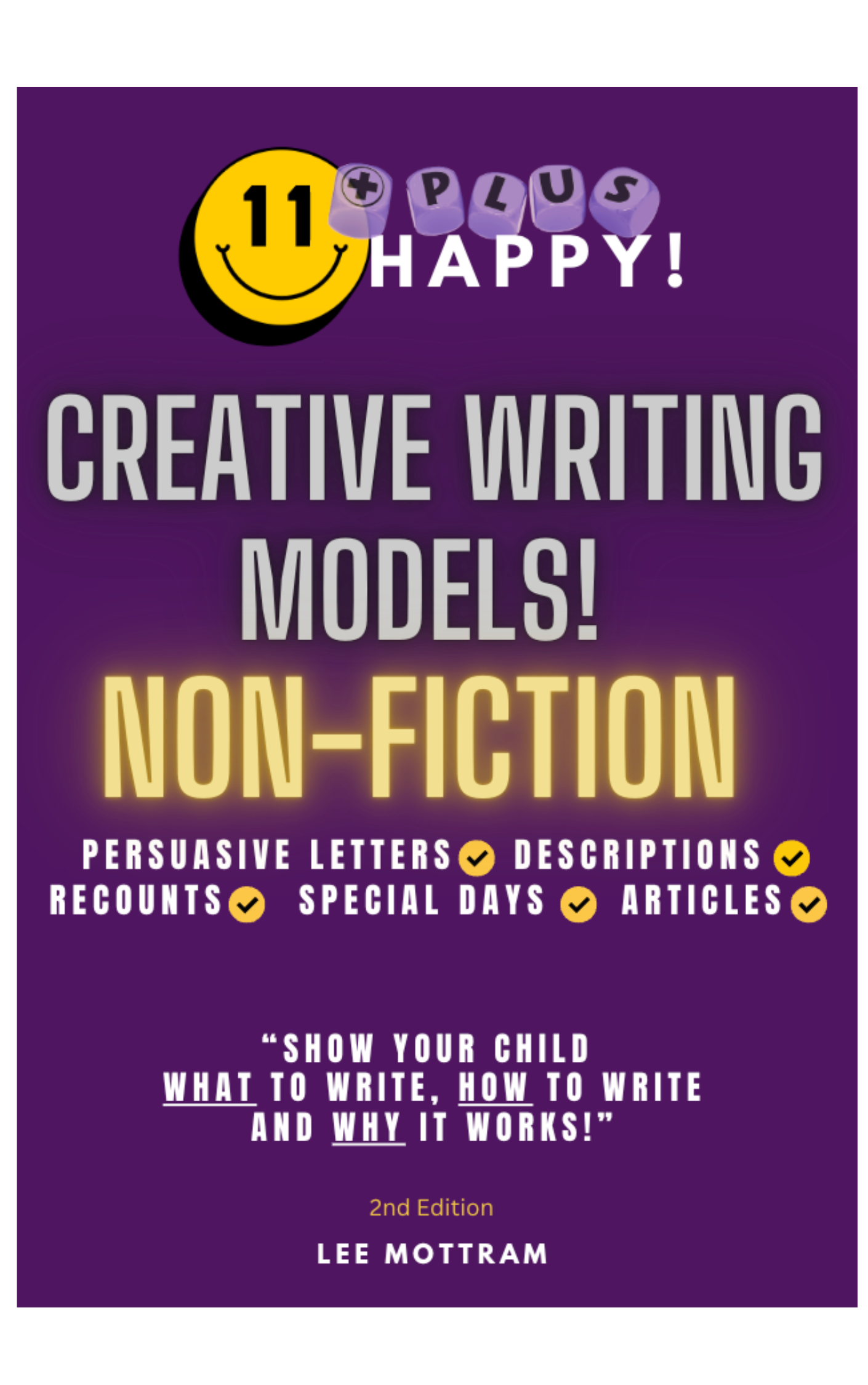
Hello! All this week, Monday-Friday, there’s a fantastically happy chance to see extracts of an eleven-plus exam-winning model of a persuasive letter, taken from my sensational book of non-fiction creative writing models.
Today, we’re going to look at:

  • The question prompt
  • The first 3 paragraphs of the letter.
  • Extracts from the What, How, Why lesson that comes with each essay. This guides you and your child through the writing features used in the model. Showing your child or student what successful writing looks like has never been easier! The sentences from the letter are in bold to help you see what writing the lesson is referring to.
  • VVV: Each essay showcases Very Varied Vocabulary that your child can use in their own work. In the book, each word comes with a definition to help your child understand and use the word swiftly in their own work.

Let’s start learning, let’s stay learning!

Extract

Question: Your favourite playing fields are to be closed and replaced by a refuse (rubbish) and recycling centre to handle the town’s waste. Please write a letter to your local council to persuade them NOT to go ahead with this plan. You must give reasons for your viewpoint. What will you lose? You will be given marks for interesting vocabulary, persuasive writing techniques, punctuation and following the structure of a letter.

Time: 45 mins

(HAPPY TIP: Don’t be tricked into thinking you can write any letter you want. Although a question might not ask you to write a formal letter, persuasive letters should mostly use formal language.)

Freshly Cottage Flats

17 Goodview Court

Sutton

SM6 3PP

Dept of Planning

London Borough of Sutton                      20th September, 2026

Dear Sir/Madam

From the address above, you may be alerted to the fact I’m one of the many concerned, frightened and – to be frank – livid residents whose lives will be ruined by the proposed building of the Refuse and Recycling centre on the site of Goodview Playing Fields.

My name is Laney, and as an 11-year-old beginning her life in the area, I stand to be affected more adversely and for far longer than the misguided grown-ups who came up with this nightmarish idea. A refuse centre instead of a park? Thus, I write for an immediate end to this ‘rubbish’ idea. There are three clear reasons to maintain the fields, with both urgent and long-term implications: the high levels of use the park has; the serious harm to children’s health; and a shock reduction in your council’s finances.

First, grasp Goodview as it is. You will know, as the local planning team, that there are 15 – yes, 15 – primary schools in the area, along with 2 secondary schools. Statistics on your own website (truthful facts, we presume) confirm approximately 8000 children study at these schools (7,873 to be exact).

WHAT, HOW AND WHY

Freshly Cottage Flats

17 Goodview Court

Sutton

SM63PP

Dept of Planning

London Borough of Sutton                                   20th September, 2040

Dear Sir/Madam

  • For fun and pun, I make up an address linked to nature to hint at which side I’m on. YOU DON’T NEED THIS, but it does show confidence and may help the work stand out.
  • I show the marker I understand the letter genre by putting the address at the top right of the page.
  • Alliteration in the address is an early sign I want to play with words.              
  • In formal letters, you could put the address of the person you are writing to on the left of the page, above the letter, but starting a line or two beneath your address. Again, it suggests confidence with the structure of a letter.
  • I write the month in words to show I can spell months. Take opportunities to showcase your learning.
  • Put the date of the test in your letter.

Dear Sir/Madam

  • The formal way to start when you don’t know the name of the person to write to. You could also use ‘To whom it may concern’. If you’re given a real name in the test, then use this. The greeting at the start changes the goodbyes at the end, as you’ll see later.

From the address above, you may be alerted to the fact I’m one of the many concerned, frightened and – to be frank – livid

  • Power of 3 and emotional language: three linked adjectives make a strong, emotionally persuasive opening. A list is a great place to show off your synonyms.
  • A double dash around my last adjective stresses that being livid (very angry) is how I really feel about closing the park. It’s a strong emotion reflecting the seriousness of the issue. Exaggeration can be persuasive.
  • Double dashes in paragraph 1 quickly let the marker see advanced punctuation.
  • Overall, I front-load my first paragraph (which is the first time my marker sees my writing) with a range of writing techniques to make a good first impression. I’m hoping that my marker may already be making their mind up that I’m a serious contender for a high mark. Obviously, don’t just throw anything in – it has to work properly to help your argument.
  • VVV: concerned, frank, livid.

residents whose lives will be ruined by the proposed building of the Refuse and Recycling centre on the site of Goodview Playing Fields.

  • The plural ‘residents’ makes me part of a group, lending social proof to my letter. It’s not just me making it up – there are lots of us who feel the same, so my letter must be taken seriously.
  • I remember capital letters for the proper noun name of the playing fields and the centre.
  • VVV: residents, proposed.

My name is Laney, and as an eleven-year-old beginning her life in the area, I stand to be affected more adversely and for far longer

  • In the first paragraph, explain who you are, why you’re writing and why the reader should listen to you. It shows the marker you’ve understood the question and purpose of writing. It also helps you stay focused on the topic.
  • An embedded clause with commas helps my punctuation sprinkle and lets me vary my sentences.
  • Hyphens help clarify ages written in words and add to my punctuation sprinkle.
  • VVV: affected, adversely.

than the misguided grown-ups

  • Repetition of hard ‘g’ sound. (This is called consonance. It sounds angry, like a growl.)
  • Re-naming grown-ups with an adjective that is negative, but not rude – ‘misguided’ – suggests they have simply been guided away from the truth, rather than deliberately avoiding it. I’m being nice and giving them a chance to change. Being kind can be persuasive, as it suggests you are not personally attacking the reader, you just want the solution.
  • I show I can use the prefix ‘mis-’

who came up with this nightmarish idea.

  • My emotional adjective re-labels something neutral – an idea – as something negative (nightmarish).

A refuse centre instead of a park?

  • A first rhetorical question to address my audience. Note that I don’t accuse the council of having this idea, I just present it in a short sentence as a simple choice between two ideas. I do this so whoever is reading the letter doesn’t get defensive and stop listening. The contrast hints at which one is the right idea.

Thus, I write to ask for an immediate end to this ‘rubbish’ idea.

  • A lovely link connective – Thus. It’s a quick way to say – “This means we can say that…”. ‘Thus’ is short enough to remember, but eloquent and effective. Thus, use it!
  • A pun on the double meaning of rubbish as a noun and an adjective. I use inverted commas to point out the pun.

There are three clear reasons to maintain the fields, with both urgent and long-term implications:

  • Power of 3: I tell the reader clearly to expect three ideas. A part of their mind now waits for these ideas, encouraging them to keep reading.
  • Colon: A colon introduces the list and helps me build my punctuation sprinkle early in the first couple of paragraphs.
  • Pretend your opinion is fact: I didn’t write ‘I think that’, I wrote ‘There are’. In truth, there may be more or less than three reasons, but I choose to claim that there ‘are’ three important reasons, suggesting my three are true facts, not opinions. This is sneaky persuasion, as it’s easier to argue with opinions, but harder to argue against facts.
  • VVV: maintain, implications.

the high levels of use the park has; the serious harm to children’s health; and a shock reduction in your council’s finances.

  • Power of 3: I present 3 reasons, which do two jobs. 1.) My reader anticipate all three reasons, so a part of their brain will not be satisfied until they hear the third reason. This will encourage them to keep reading. 2.) It helps you structure your letter, since you lay out at the start what you are going to write about. This will help you write faster, and write more, as you know in advance what you want to say.
  • Semicolon list: Separating the list items with semicolons is a fantastic way to split up longer phrases and sentences (e.g. the serious harm to children’s health). It helps your reader know which information belongs to which reason.
  • Punctuation sprinkle: Adding semicolons to your list of reasons in the first couple of paragraphs lets you show off advanced punctuation and make a strong first impression. Your marker will be impressed. It also means that if you forget to use a semicolon again, it doesn’t matter, since you have already done it!

First, grasp Goodview as it is.

  • Blender: A link connective combined with alliteration.

You will know,

  • Direct Address: The second person ‘you’ suggests a fact in my argument is a truth the planner may already know about. Speaking directly to your reader is an important feature in persuasive writing. The pronouns ‘you’ and ‘your’ will help.

as the local planning team,

  • An embedded clause for sentence variation.

that there are fifteen – yes, fifteen –

  • Repetition for emphasis.
  • Dashes work like spotlights, highlighting the large number.
  • Punctuation sprinkle.

primary schools in the area, along with two secondary schools. Statistics on your own website (truthful facts, we presume)

  • I use the planners’ own facts against them! They can’t deny their own words.
  • Brackets help my punctuation sprinkle.
  • The pronoun ‘we’ unites reader and writer, as well as reminding the reader I am one of many who feel upset about the decision. I’m suggesting we all know the truth about the high number of children using the park.
  • VVV: presume.

confirm approximately eight thousand children study at these schools (7,873 pupils to be exact).

  • Brackets let me include an exact figure without interrupting my argument. Precision makes them appear believable.

Boom! That’s it for today. How was that? I hope iso much that it’s helpful in getting you started. The semicolon list of reasons at the start of a persuasive letter is an absolute winner that your child can rely on to start with dazzle! Why not go and teach them this is they are not doing so already. We’ll continue the letter and lesson tomorrow (Tuesday).

If you’re ready for your full copy, then please do dive in here:

or click on the happy pic!
You can also visit the books and downloads page at www.11plushappy.com to see this and other good stuff to help your child pass with a smile.

Please let me know any thoughts, or if something has helped you at leemottram@11plushappy.com.

Have a beautiful day of learning. See you tomorrow, and please do share this with a parent or tutor if you think it may be of help.

Lee, London

Quick…A sneak peak inside my Creative Writing Models Non-Fiction Guide!

With a new Non-Fiction Models book issued fresh for 2025, I’m dying to show you an extract from a persuasive letter, so you can see exactly how the guide will transform your child’s writing. Remember, each model in the book gives you:

  • A Question Prompt.
  • A short plan – the kind your child can actually put together in a couple of minutes.
  • The full model – Show your child what finished exam writing looks like to help them imagine it clearly. It’s like seeing a picture of a cake in a recipe book. Your child needs to know what they’re aiming for. Each model has all the must-write ingredients of exam-passing writing to super-boost your child’s mark.
  • A full, line by line or paragraph by paragraph lesson of every writing technique and structure point in the model, so your child can see what, how and why the writing works.
  • A vocabulary section with definitions of stretching, dazzling words for your child to use in their writing, to build eloquence and wow any marker!

It’s a guide to make your parent-and-child and tutor-and-child learning moments easy, valuable, and most importantly, to guarantee your child KNOWS how to make progress in every creative writing lesson and session. Yes, if you’d care to leap ahead in learning straight away, you can order your copy of the book on these links:

From Monday through to Friday, I’ll serialise extracts from the model and lessons – the full model and lesson taken from the book is 13 pages! We’re talking mountains of help and guidance!

My parents and children love this guide because it works: students progress quickly in all areas of exam-passing creative writing. Remember, I wrote the guide as a teaching tool, which use continually with my young writing legends – because it works. It’s your turn! Please come back to my 11plushappy.com blog on Monday. Here’s the sneak preview of what’s coming… Why not ask your child how many features they can spot in the opening paragraphs below?

Extract

Question: Your favourite playing fields are to be closed and replaced by a refuse (rubbish) and recycling centre to handle the town’s waste. Please write a letter to your local council to persuade them NOT to go ahead with this plan. You must give reasons for your viewpoint. What will you lose? You will be given marks for interesting vocabulary, persuasive writing techniques, punctuation and following the structure of a letter.

Time: 45 mins

(HAPPY TIP: Don’t be tricked into thinking you can write any letter you want. Although a question might not ask you to write a formal letter, persuasive letters should mostly use formal language.)

Freshly Cottage Flats

17 Goodview Court

Sutton

SM6 3PP

Dept of Planning

London Borough of Sutton                      20th September, 2026

Dear Sir/Madam

From the address above, you may be alerted to the fact I’m one of the many concerned, frightened and – to be frank – livid residents whose lives will be ruined by the proposed building of the Refuse and Recycling centre on the site of Goodview Playing Fields.

My name is Laney, and as an 11-year-old beginning her life in the area, I stand to be affected more adversely and for far longer than the misguided grown-ups who came up with this nightmarish idea. A refuse centre instead of a park? Thus, I write for an immediate end to this ‘rubbish’ idea. There are three clear reasons to maintain the fields, with both urgent and long-term implications: the high levels of use the park has; the serious harm to children’s health; and a shock reduction in your council’s finances.

First, grasp Goodview as it is. You will know, as the local planning team, that there are 15 – yes, 15 – primary schools in the area, along with 2 secondary schools. Statistics on your own website (truthful facts, we presume) confirm approximately 8000 children study at these schools (7,873 to be exact).

Let’s go! If you’d like to know what features are in here and why they work, please bookmark or add Monday 19th May to your calendar. I hope next week’s blog adds ease, smooth-tempers and happy learning to your week.

Oh, by the way, I’m deliriously excited about launching a podcast soon, to help you if you’re an on-the-go thinker and learner. I’ll share more details soon. Season 1 is almost finished recording!

Again, here are the book links, the digital bookshelves, if you want to dive in and make progress straight away.

Stay happy, stay learning.

Any questions? leemottram@11plushappy.com

Lee, London. May 25

Paperback books or digital books – which is better for your child’s learning?

Your decision to choose a digital or paperback version of a teaching and learning book depends on:

  1. What you plan to do with it.
  2. Where you’re doing the learning.
  3. How your home is set up.
  4. The possibility of buying a bundle of both versions, if the discount is massive.

Why you should love digital versions

With printing-enabled ebooks – all 11plushappy guides have printing ability – you can print out one essay at a time, multiple times. You and your child can write all over it and annotate it with notes to help you learn. For example, find and underline all the verbs, find all the similes, circle any writing imagery you want to magpie, and so on.

Because you’re printing this on paper, it’s great to get a pencil and paper learning session going. If it goes wrong, or even if it goes right, but the pages get crinkled or torn, you can print the chapter again! Nothing wasted. Likewise, take a chapter to a cafe, out to the park, or have a picnic in your garden, and you can easily create a Learning Cafe, where your child can relax and learn almost invisibly while slurping up a milkshake.

Another advantage is if you make a copy and store it on a drive or in the cloud, you can’t lose the book! Ever! You can take it on holiday, in the car, on the plane, without needing to worry about losing or damaging that one paperback copy you have; a real book is, after all, pretty much a living breathing thing deserving as much love as a pet!

Being able to print out sections also gives you the same advantage as a paperback book – you and your child don’t have to look at it on a screen all, or even any, of the time.

So when you buy a digital book, you’re really buying many copies of it to work on. True, a book can be photocopied, but you need a photocopier, and it takes a lot of time. An ebook printout is press and go. Helpful if you have two kids and want to use the same resource, all clean, or if you want to revisit the learning afresh with your child. I know there are copyright issues here, but I’m realistic. I know you’re going to print it out and make an extra copy. I want you to. You buy non-fiction books as tools to build something greater – your child’s learning and exam success.

Why you should love paperback versions

Well, it’s a book. Paper is going to be better for your eyes, A precious living thing, as we’ve mentioned. Something to look wonderful on your table, to pull out of a school bag, to take with you wherever you do your learning. A book is stronger than a print out, and will resist a lot of use. It can survive coffee, juice spillages, sticky fingers, even the beach.

It’s not digital and it’s better for your eyes. A book doesn’t run out of batteries. You don’t need any device to access a book. It’s there in your hands, in your life, immediately.

A real book on a shelf or on a table? Surely, one of the most beautiful, empowering sights in the world!

A paperback book teaches your child to hold books and work with them. You will help your child see books as a real alternative to phones, screens, videos, etc.

You can still write all over a book. ALL my non-fiction books are covered with notes, in pencil, pen and highlighters. You can use it as a tool and accept it’s going to get dirty. It’s fine; this is your child’s own copy. They will feel proud to have a possession they can personalise with names, stickers, colouring pens, post-it markers and their own handwriting.

Physical books make fantastic gifts, helping relatives to support families and grandchildren, nephews and nieces. There’s the thrill of the postbox, the delivery.

The main downside of a book is the risk it gets lost or damaged. You can’t make another copy. When it’s gone, it’s gone. Admittedly, though, this doesn’t happen too often.

I hope these thoughts help you decide which is right. 11plushappy guides are available in digital and paperback formats, so you are looked after whatever you prefer. But hold on…I’ve had an idea.

What if you could own both and make a huge saving?

What if there was a third way? What if, like me, you don’t want to choose? In a perfect world, you could have a digital and a paperback, right? But it would be too expensive and a waste of money to buy two versions of the same book, right? I thought the same, so I decided to create a double bundle of a digital and a paperback version of the guides at a £20 discount. Yey! Now you can choose not to choose. Now, you and your child can learn with a digital AND a paperback book.

£30 gets you both book formats, giving you all of above benefits. (That’s only £5 for the second book.) You’ll download your digital copy immediately, and receive your paperback in the post. Oh, and I pay for the postage, so that’s free to you.

Visit the http://www.11plushappy.com bookstore to start learning today.

I really hope this reading helps you decide. I’m really happy that I can now offer you three ways to help your child stay 11 plus happy!

Have a beautiful week of teaching and learning.

Lee, London

Eleven Plus Parents – You CAN do this!

Well, another week means another opportunity to help your child as they prepare for their 11plus. How is it going? Two very simple messages today. One is up there in the title. You CAN do this. Thousands of children do pass each year, these schools do exist, they do accept children, and you have an equal chance to any other parent-and-child partnership of making it.

The second message is vast in its smallness: you, as a guide, only have to be one step ahead of your child when it comes to teaching them a particular skill. You don’t need to be a teacher, you really don’t. You don’t have to know the whole curriculum. You really don’t. You’ll end up knowing the whole curriculum, but you do not need to know everything to start.

Rather, spend the day or evening before a session with your child learning the one topic you are planning to cover. With the online world, you are never far from finding dozens of resources and lessons and free videos to get going. Choose 2-3 resources ( I think it’s useful to have different approaches to a topic, to help you take a broader view) and spend an hour looking at the information.

As long as you’re prepared to be a beginner, and as long as you don’t worry yourself about what you don’t know, you’ll make great progress, and you’ll help your child make progress.

It’s not about what you know now, it’s not about your own educational background. Honestly, it’s not. When I was helping my first child, I realised there was so much maths I hadn’t learned or remembered from school. Even at teacher training college, several tutors brought up again and again that there was a belief among many student and professional teachers they were not ‘good’ at Maths, which was totally false, and based on either old-school learning or the fact that as we hadn’t used it daily in our lives, it wasn’t in our working memory. I actually fell in love with maths only at teaching college; at school…well, I hardly remember anything from my own primary lessons. Yet I learned it along the way, or rather re-learned it, and now I teach it with a real fascination and passion, alongside my relentless passion for English and the spoken and written word. My first helpful book was the original Bond How to do 11 Plus Maths books, which had short, but so incredibly helpful, introductions to many of the subjects. Each step takes you onto the next step.

We are grown ups and we can help our children and we can feel good, not bad, about teaching ourselves just enough to guide them. These are tests for children, so please remember that. They are designed to be tricky, they are designed to catch people out, but they are also designed to be passed!

So please, breathe out, smile, and remember:

  • You can do this.
  • You are not alone.
  • You only have to be one step ahead in one subject.
  • It is definitely okay to learn along with your child.
  • It’s okay to say, “Ooh, I don’t know about this yet, let’s go and find out.” Admitting you don’t know everything will often make your child feel better about learning, as they realise it’s natural to not know things!

Okay, 11plus parent, okay 11plus tutor, okay, 11plus child-superhero – have an incredible week. Time is our greatest tool. Smiling and relaxing might be our second greatest tool. Now, you can go to the subject at hand and learn your way through the week.

Start learning, stay learning, stay happy. Lee

Eleven plus Non-fiction Models offer a fast track to your child’s writing success.

Why models?

  • Because models work. Ever followed a how-to guide on YouTube? You’ve learned from modelling. It can be a very rapid way of achieving excellent results.
  • Because models are fair. As a teacher, I think it’s very unfair we ask children to write an excellent piece of non-fiction, unless they first see, read, learn and practise what ‘excellent’ looks like.

It’s all very well people telling you to write a great persuasive letter or recount or description, but what does that really mean? How much do you write? How do you start? How do you end? What techniques and structure should you include?

Children need to know what success looks like, so they can aim for it. Success leaves clues.  Lego toys come with pictures and instructions for a reason.

My promise in writing this brand new guide, 11 Plus Happy Creative Writing Models: Non-Fiction Edition is to maximise your child’s learning, to help them score the highest mark they possibly can. My vision is that anyone who reads, learns and follows the steps in this book will become some of the best writers in the room – perhaps the best writer in the room. With this in mind, I also promise that this guide is about MUCH MORE than the models.

Our shared commitment is we want your child to pass their 11 Plus creative writing with a very, very high mark. Our shared commitment is we’ll work and write a lot of deliberate practice writing along the way, using the tools in this guide. Our shared aim is to dazzle the marker with writing that stands out from the hundreds, perhaps thousands, of others. Our shared aim is that your children feel confident, equipped and ready to rock any exam. To make this a reality, each non-fiction model comes with the following:

  • A question prompt, so your young writer understands what each essay is trying to answer.
  • A model of a short plan – the kind you can actually write at the start of a time-pressured exam. Even the shortest plan will help you write the correct amount and make sure you stick to answering the question. You’d be surprised how often children write something completely different to what the question asks for. Or, they start by answering the question correctly, but then drift onto another topic or style of writing half way through.
  • The full model essay.
  • A huge and powerful lesson chapter: WHAT, HOW, WHY. We’ll zoom in to the micro-details, the many parts that make up a whole piece. The aim is clear: your child (that’s YOU if you’re the child!) will know what to write, how to write, and understand why they should write in this way.
  • VVV: A Very Varied Vocabulary section. Throughout the essays, we’ll collect dazzling and interesting words that I think you should use.
  • A list of the very varied vocabulary used in each piece of writing comes at the end of each chapter.
  • A definition for each word (as it’s used in the text) to help you write quickly with this jaw-dropping vocabulary.

This is the book I needed as a teacher. This is the book children deserve to read in order to help them see what finished exam-passing writing looks like, as well as understanding how that writing is put together. This is the book for the superhero parents who are actively involved in helping their child learn and prepare for 11plus success. This is a book that will support tutors in teaching creative writing.

But it’s not about the book; it’s about your child’s writing improving in each session. It’s about your child’s enjoyment and understanding of creative writing. It’s about your child feeling confident and skill-equipped to write a wide range of non-fiction essays.

Growing up, my mum and dad used to say often: “Children come first, second, third and last.” Before anything, consider the children. I know it’s why I became a teacher, I know it’s why I adored and continue to love being a dad. This book is part of that belief system.

Order your copy and let’s help your child reach their highest mark. Yes!

Eleven plus Non-fiction Models offer a fast track to your child’s writing success.

Why models?

  • Because models work. Ever followed a how-to guide on YouTube? You’ve learned from modelling. It can be a very rapid way of achieving excellent results.
  • Because models are fair. As a teacher, I think it’s very unfair we ask children to write an excellent piece of non-fiction, unless they first see, read, learn and practise what ‘excellent’ looks like.

It’s all very well people telling you to write a great persuasive letter or recount or description, but what does that really mean? How much do you write? How do you start? How do you end? What techniques and structure should you include?

Children need to know what success looks like, so they can aim for it. Success leaves clues.  Lego toys come with pictures and instructions for a reason.

My promise in writing this brand new guide, 11 Plus Happy Creative Writing Models: Non-Fiction Edition is to maximise your child’s learning, to help them score the highest mark they possibly can. My vision is that anyone who reads, learns and follows the steps in this book will become some of the best writers in the room – perhaps the best writer in the room. With this in mind, I also promise that this guide is about MUCH MORE than the models.

Our shared commitment is we want your child to pass their 11 Plus creative writing with a very, very high mark. Our shared commitment is we’ll work and write a lot of deliberate practice writing along the way, using the tools in this guide. Our shared aim is to dazzle the marker with writing that stands out from the hundreds, perhaps thousands, of others. Our shared aim is that your children feel confident, equipped and ready to rock any exam. To make this a reality, each non-fiction model comes with the following:

  • A question prompt, so your young writer understands what each essay is trying to answer.
  • A model of a short plan – the kind you can actually write at the start of a time-pressured exam. Even the shortest plan will help you write the correct amount and make sure you stick to answering the question. You’d be surprised how often children write something completely different to what the question asks for. Or, they start by answering the question correctly, but then drift onto another topic or style of writing half way through.
  • The full model essay.
  • A huge and powerful lesson chapter: WHAT, HOW, WHY. We’ll zoom in to the micro-details, the many parts that make up a whole piece. The aim is clear: your child (that’s YOU if you’re the child!) will know what to write, how to write, and understand why they should write in this way.
  • VVV: A Very Varied Vocabulary section. Throughout the essays, we’ll collect dazzling and interesting words that I think you should use.
  • A list of the very varied vocabulary used in each piece of writing comes at the end of each chapter.
  • A definition for each word (as it’s used in the text) to help you write quickly with this jaw-dropping vocabulary.

This is the book I needed as a teacher. This is the book children deserve to read in order to help them see what finished exam-passing writing looks like, as well as understanding how that writing is put together. This is the book for the superhero parents who are actively involved in helping their child learn and prepare for 11plus success. This is a book that will support tutors in teaching creative writing.

But it’s not about the book; it’s about your child’s writing improving in each session. It’s about your child’s enjoyment and understanding of creative writing. It’s about your child feeling confident and skill-equipped to write a wide range of non-fiction essays.

Growing up, my mum and dad used to say often: “Children come first, second, third and last.” Before anything, consider the children. I know it’s why I became a teacher, I know it’s why I adored and continue to love being a dad. This book is part of that belief system.

Order your copy and let’s help your child reach their highest mark. Yes!