Exclusive 1:1 Online Tuition!

If you’re searching for happy, successful 1:1 English tuition – no groups – please get in touch at leemottram@11plushappy.com, and visit http://www.11plushappy.com to learn more about me, my books and my lessons.

Let’s help your child reach their highest mark!

Regards, Lee Mottram,

BA English Literature, PGCE Primary Teacher, 17 years tuition experience

24-25 Successes include: Tiffin Girls & Boys, Sutton Grammar, Nonsuch Girls, Wallington Girls, Wallington Boys, Halifax Grammars, KGS, Freemans

Paperback books or digital books – which is better for your child’s learning?

Your decision to choose a digital or paperback version of a teaching and learning book depends on:

  1. What you plan to do with it.
  2. Where you’re doing the learning.
  3. How your home is set up.
  4. The possibility of buying a bundle of both versions, if the discount is massive.

Why you should love digital versions

With printing-enabled ebooks – all 11plushappy guides have printing ability – you can print out one essay at a time, multiple times. You and your child can write all over it and annotate it with notes to help you learn. For example, find and underline all the verbs, find all the similes, circle any writing imagery you want to magpie, and so on.

Because you’re printing this on paper, it’s great to get a pencil and paper learning session going. If it goes wrong, or even if it goes right, but the pages get crinkled or torn, you can print the chapter again! Nothing wasted. Likewise, take a chapter to a cafe, out to the park, or have a picnic in your garden, and you can easily create a Learning Cafe, where your child can relax and learn almost invisibly while slurping up a milkshake.

Another advantage is if you make a copy and store it on a drive or in the cloud, you can’t lose the book! Ever! You can take it on holiday, in the car, on the plane, without needing to worry about losing or damaging that one paperback copy you have; a real book is, after all, pretty much a living breathing thing deserving as much love as a pet!

Being able to print out sections also gives you the same advantage as a paperback book – you and your child don’t have to look at it on a screen all, or even any, of the time.

So when you buy a digital book, you’re really buying many copies of it to work on. True, a book can be photocopied, but you need a photocopier, and it takes a lot of time. An ebook printout is press and go. Helpful if you have two kids and want to use the same resource, all clean, or if you want to revisit the learning afresh with your child. I know there are copyright issues here, but I’m realistic. I know you’re going to print it out and make an extra copy. I want you to. You buy non-fiction books as tools to build something greater – your child’s learning and exam success.

Why you should love paperback versions

Well, it’s a book. Paper is going to be better for your eyes, A precious living thing, as we’ve mentioned. Something to look wonderful on your table, to pull out of a school bag, to take with you wherever you do your learning. A book is stronger than a print out, and will resist a lot of use. It can survive coffee, juice spillages, sticky fingers, even the beach.

It’s not digital and it’s better for your eyes. A book doesn’t run out of batteries. You don’t need any device to access a book. It’s there in your hands, in your life, immediately.

A real book on a shelf or on a table? Surely, one of the most beautiful, empowering sights in the world!

A paperback book teaches your child to hold books and work with them. You will help your child see books as a real alternative to phones, screens, videos, etc.

You can still write all over a book. ALL my non-fiction books are covered with notes, in pencil, pen and highlighters. You can use it as a tool and accept it’s going to get dirty. It’s fine; this is your child’s own copy. They will feel proud to have a possession they can personalise with names, stickers, colouring pens, post-it markers and their own handwriting.

Physical books make fantastic gifts, helping relatives to support families and grandchildren, nephews and nieces. There’s the thrill of the postbox, the delivery.

The main downside of a book is the risk it gets lost or damaged. You can’t make another copy. When it’s gone, it’s gone. Admittedly, though, this doesn’t happen too often.

I hope these thoughts help you decide which is right. 11plushappy guides are available in digital and paperback formats, so you are looked after whatever you prefer. But hold on…I’ve had an idea.

What if you could own both and make a huge saving?

What if there was a third way? What if, like me, you don’t want to choose? In a perfect world, you could have a digital and a paperback, right? But it would be too expensive and a waste of money to buy two versions of the same book, right? I thought the same, so I decided to create a double bundle of a digital and a paperback version of the guides at a £20 discount. Yey! Now you can choose not to choose. Now, you and your child can learn with a digital AND a paperback book.

£30 gets you both book formats, giving you all of above benefits. (That’s only £5 for the second book.) You’ll download your digital copy immediately, and receive your paperback in the post. Oh, and I pay for the postage, so that’s free to you.

Visit the http://www.11plushappy.com bookstore to start learning today.

I really hope this reading helps you decide. I’m really happy that I can now offer you three ways to help your child stay 11 plus happy!

Have a beautiful week of teaching and learning.

Lee, London

New for You! 15 top-level non-fiction models to help your child be the best writer in the exam room

A year in the writing, informed by hundreds of hours of teaching, and already helping people win success in dozens of 11plus entrance exams, please may I introduce an absolute must-have for your book-shelf or digital library in 2025:

In digital:

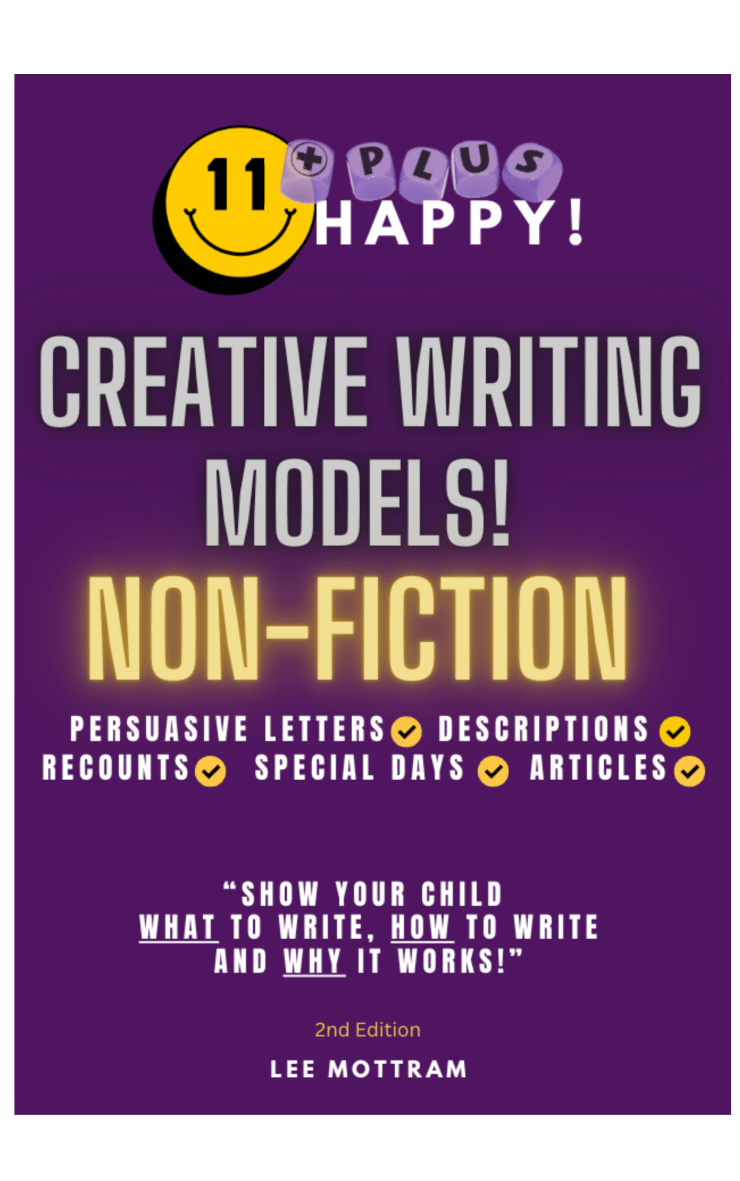
11 Plus Happy Creative Writing Models! Non-Fiction Edition: Instant Ebook Download

11 Plus Happy Creative Writing Models! Non-Fiction Edition: Instant Ebook Download

£25.00

For Parents, Children and Tutors. 11plus just got happier!  15 top-level models of the most common non-fiction exam questions. Matches exam time and word count. Expert lessons for every feature in every essay, with pages and pages of rich explanations, so that your child can emulate and own each skill.  From plan to punctuation to … Continue reading 11 Plus Happy Creative Writing Models! Non-Fiction Edition: Instant Ebook Download →

In paperback from Amazon:

What are you teaching your child today?

Seriously. Let me know. Have you planned it?

It’s the most important question to know the answer to make sure they make progress each day.

It might be five minutes on a times table, silent letter spellings, or something longer like a piece of creative writing. you need to know to make it happen.

Repeat for tomorrow, but first today.

You might change what they learn tomorrow based on how they do today.

You can do it. They can do it. Your child can learn the next part of their 11 plus journey.

My learning today was to write this blog on a phone, a new skill for me. My wife has been diagnosed with cancer, so we are spending a lot of time in hospital waiting rooms waiting for our medical miracles, and I wanted to figure out a way to keep writing the blog. One app download later, here we are, waiting for an echocardiograph.

So, what are you teaching your child today?

They will love the time together with you.

Best Lee,

Stay learning, stay happy.

Learn Out Loud – please read with your voice turned up!

Because the week is about fun,

I thought – how can I show ‘em?

Then some words raced into the room

And yelled: “Just write a poem!”

Mums and dads – they need fun too

They might have grumpy faces

Just speak in an unusual way

And take them to fun places

It might go right, it might go wrong

That’s not the point because

Our playful purpose is to pass

Our child’s 11 plus.

Perhaps you’ll say: “Today,

Our lesson starts under the table.”

Then with a preposition, move it

Everywhere you’re able

Splashing through a puddle,

Sprinkling water on your face,

You’ll say, “This ‘ain’t no lesson, child,

This is a Maths Café!”

A milk shake and some paper and a pencil and a jug

Turn milk to millimetres and then finish with a hug

I could go on forever, but I better stop today

So you can go and have some fun in your English Café.

This last verse has adverbs of time, this poem has showed you how

Your child learns longer with a laugh…so go and teach them NOW!

Happy learning. Let me know if you enjoyed today’s learning snack.

Lee, with a smile on his face, London

November 2nd, 2023

Children’s Planner for 11plus Tuition and Homework available NOW!

Hi everyone, I made a planner! I designed it for my own children and families, so they could have a rock-solid method of handing over learning and homework. The kids and parents love it and I wanted to share it with you. You may love it, too!

Tuition just got happier! If you’ve ever asked your child what homework their tutor has set them, only to get the reply: “Um…I can’t remember,” this child-friendly journal is going to change your life. Bring to every tuition or home learning session and never lose track of homework and learning again. A trustworthy A5 planner to make children, families and tutors happier while boosting Eleven Plus, KS2 and Lower KS3 education, from the learning-obsessed team of one at http://www.11plushappy.com.

  • Designed with children in mind.
  • Glossy, beautiful and bright, wipe-clean cover to survive real life, school bags and snack fingers! Children will be happy to own and bring this to every lesson.
  • Easy A5 size – child and backpack friendly!
  • 198 pages – Track and record up to 2 years of tuition or home learning.
  • Welcome page to draw and add personal details.
  • Your child can write in their happy reasons for studying and learning – encourages commitment and motivation.
  • Child-friendly question prompts to help with mind maps, after-lesson reflection and learning.
  • A reliable shared space for everyone: children, tutors and families.
  • Ask your child’s tutor a question in the space provided.
  • Dedicated mind map space to draw and note key remembered information after each lesson. Aids memory retention and deeper learning.
  • Break-out space for doodling and relaxing.

Click here to get your child organised!

No other planner is designed with such a happy focus on improving learning by bringing children, families and tutors together.
Are you ready to help your child reach their highest mark? Click and order yours today.
Are you looking forward to never not knowing what your child’s homework is again?

  • Perfect for parents and family members supporting children preparing for 11plus entrance exams for grammar and Independent schools. Your child is doing amazing things – let’s make the journey smooth.
  • Perfect for all Eleven Plus, KS2 Primary and Lower Key Stage 3 tuition and home learning.
  • A super-helpful, practical solution for committed tutors searching for a way to develop communication with families and make everyone’s time easier, more efficient, effective and happier. Set yourself apart by gifting or recommending this planner to your students.

Pick up your child-friendly, family-friendly and tutor-friendly planner here!

Go Backwards Technique – score higher in 11plus practice tests and writing

“You can steer yourself any direction you choose.”

Dr Seuss

The Go Backwards technique is an ally of the Go Forwards technique.

Very simply, do the test until finished, no matter how long it takes.
How long did it take? As with yesterday’s Go Forwards Technique, celebrate this – you have a benchmark to start from. For the next test, issue a new challenge:

Can you knock a minute off your last time?

Example: Your child takes 68 minutes to finish a 40-minute test. Praise them for finishing it and agree you have a brilliant place to start. Enthuse them by letting them know they’re just 28 tiny steps away.

Next test, can you do it in 67?

Sometimes this cuts as much as five minutes off the first time you try it. Don’t worry if not, a minute is all we’re after. Whatever the new time – as long as it’s quicker than the last time – this now becomes the new time to beat by a minute. If they don’t beat it, then stick to the first time as the one to beat. (Avoid setting a slower time as the starting point.)
After twenty tests over a couple of months, your child should be on their way to finishing within, or very close to, the given time.

Your power in this step is to simply keep going – one minute less, one minute less, perhaps pacing this challenge to every 2-3 tests, until they are within the range. Mixing in with the Go Forwards technique may be a happy and helpful pattern for variety.

Key to the success of the Go Backwards technique is don’t try and take too much time off at once.

Don’t push your child to finish in half the time; this will likely lead to rushing and an increase in mistakes. It’s a balancing act and an adventure. You are promoting a gentle reduction.

A challenge is never – you must; it’s a fun experiment – Shall we see if we can?

Again, the Go Backwards Technique works well with creative story writing. Suppose your child writes 2 pages (see next page) and it takes them an hour and a half. By now, you know what we do: celebrate the pages and use the time as a benchmark. Next story, can you write 2 pages in 89 minutes? Continue in this way. Even if it takes takes three days to write 2 pages. Next story, two days, then one and a half days, and so on. Over the long term, they may well be at fifty minutes. The art of the possible. Just keep swimming, as Dory says. 49, 48, etc.

For a 25-minute piece of writing, a page and a paragraph to a page and a half is an excellent amount to aim for. This turns out to be around 7-8 paragraphs with around 5 lines to a paragraph.


For a 40-60-minute test, plan and practise writing between 2-2½ pages, around 10-12 paragraphs.


Any less and there may not be enough material to mark or show strength, nor will there be enough space to put in all the essential ingredients of a stand-out piece of writing; any more and your child may not have time to go back and check.

One of the easiest ways to win points can be for your child to go over things they’ve just written and check punctuation, spelling, grammar, and perhaps swap words for more exciting ones.

It’s likely for any of us that in a first draft (which a test piece of writing is) we will miss things, misspell homophones, leave out punctuation, or use a word that we would rather change for a better one, and so on.

Do you want to help your child’s writing better? The best it can be? Two further truths matter:
1) SPACED time. By which we mean, start early and give them the habit of writing regularly over a period of months, if not years.
By starting early, you are not adding pressure, you are removing it.

2) Deliberate writing with a deliberate purpose for most pieces. For example, in one story, work on using all punctuation, while in the follow up, focus on similes or structure, while preserving the previous punctuation.

Fold in features like folding ingredients in a recipe one by one. You are baking a happy learning cake that will rise slowly and steadily.

Of course, we need to say that not all writing should be controlled. In some practice sessions, freedom to write is everything. Two absolute benefits of not worrying about time in some writing sessions is that creativity and imagination come out to play, while you will probably with more writing to assess, giving you a clearer view of what the next steps might be.

In rehearsal writing, feel free to jump up and down with real enthusiasm and appreciation for the words your child has written. I love this quote, it’s at the root of driving happy, successful learning:

“Nine tenths of education is encouragement.” – Anatole France.

I enjoy celebrating and finding out what students don’t know, as it means we can teach them the gaps and increasingly run out of things they don’t know or can’t yet do.

BUT…I love just as much taking every chance to appreciate and congratulate children for what they have written successfully in each story or essay. We grow more of what we want with specific praise and general and abundant love and encouragement.

Encouragement, enthusiasm and praise ARE teaching tools.

Why do spectators cheer during the 100m? During marathons? What are they giving
to the athletes that the athletes don’t already have? Give the same feeling to your child. It’s wonderful.
To sum up, the Go Backwards Technique helps:

  1. Coach your child to work towards finishing the test in time by gradually
    reducing each test by a minute.
  2. Reduces the time taken to write an 11+ story or piece of non-fiction, while
    increasing the passion and quality of their writing because you value every
    sentence along the way while encouraging them to slowly blend in more ‘must-haves’ of dazzlingly brilliant creative writing.

I hope this post helps you. Please share and subscribe. Let’s help children reach their highest mark with a smile on their face.

Stay happy,

Lee, London

Go Forwards technique: How to use time to get better scores in 11plus practice tests

“Only those who will risk going too far can possibly find out how far one can go.”

T.S.Eliot

Happy Classroom 3 (Part 3 of a series on how time helps your child prepare and pass.)

The Go Forwards technique has one aim: increase the number of questions
your child can answer within the time set by the target school.


How long is each part of your child’s test? Check with your chosen schools.
Most tests look something like this:
• Stories/recount/creative writing tests: 25 minutes, or 40-60 minutes.
• English comprehension/grammar/multiple choice: 30-50 minutes.
• Maths papers multiple choice/written: 40-60 minutes
• Verbal and non-verbal reasoning papers: 30 to 50 minutes.
• Combined English/verbal reasoning: 45minutes
In weekly practice tests, both you and your child can use the following 4 steps:

  1. Note the time allocated to a given practice paper.
  2. Begin the test and stop exactly when the time says, whether you have
    finished or not.
  3. How many questions did your child leave out? Three, ten, fifteen? Regardless
    of the number, congratulations – your child now has a starting point that lets
    you both know what he or she can do within the time.
    Now comes the value. Set your child a fun challenge:
  4. Can you answer just 1 more question within the given time in the next test?
    Interestingly, by trying to beat a score by one, they may answer 2 or 3
    more, just by being aware of it.
    Next test after that, the same challenge – can they answer just one more question
    than in the previous test?
    You can work out that over a couple of months, it’s quite possible for your child to be
    answering all the questions within the given time.
    Just by increasing the number of questions they can confidently answer by 1 each
    time.
    The key is a GRADUAL INCREASE. It is the art of the possible. The art of
    happy. Better to first answer questions correctly, then answer quickly.

Eventually, a month before the test day at least, although it could be much sooner,
your child looks to finish practice tests with around 5 minutes to spare to use for
checking time.

Introduce speed slowly. (Oxymoron alert – speed slowly…hmm.)

(Musical instrument lessons follow a similar method.)
It is better to learn to recognise the tricks multiple choice tests play, better to learn
neat and effective ways to find the information and avoid the tricks played by the
answers; thereafter, turning up the speed will have a purpose. Is there any point in doing something wrong fast?


HAPPY TIP: The Go Forwards technique is also a fantastic booster for creative
writing practice.


If your child writes a couple of paragraphs in an initial session, praise them, then in
the next session, issue a relaxed challenge to write one more sentence next time.
Continue to issue fresh challenges to add extra sentences in the next piece of
writing.

You may wish to pace this challenge to every second or third piece of writing, so they are not always thinking of increasing quantity at the expense of quality.

I hope this is helpful advice. Please come back for classroom 4 in the next couple of days.

Lee, London